The deadline is December 31, 2027. On that date, every retail point-of-sale system in global commerce is expected to read a GTIN encoded in a 2D barcode — a QR code or GS1 DataMatrix — alongside the traditional UPC and EAN labels that have been on product packaging since 1974. This transition has a name: GS1 Sunrise 2027. For brands and manufacturers who have not started planning, the window to act is closing.
What GS1 Sunrise 2027 actually is
GS1 is the international non-profit organization that manages the barcode standards used in global retail — the organization that issued your company prefix, standardized EAN-13, and built the application identifiers that make supply chain data readable across systems. In 2020, GS1 set a global industry target: by the end of 2027, every retail POS system worldwide should be capable of scanning and processing a GTIN carried in a 2D barcode.
This is not a replacement of the traditional barcode. It is an addition. During the transition period and likely beyond, a 1D UPC or EAN will still appear on packaging. What Sunrise 2027 requires is that the infrastructure — the scanners, the software, the POS systems — can also read a 2D code that carries the same GTIN, and potentially much more.
Walmart, Target, Tesco, Carrefour, Kroger, and Dillard's have all committed to 2D-capable POS infrastructure on or ahead of the 2027 timeline. When the largest retailers in every major market align on a common deadline, the word “voluntary” loses most of its meaning for any brand that wants shelf space.
Why this transition is happening now
The traditional UPC barcode is a one-dimensional data carrier. Scan it at a checkout terminal and it returns a 12-digit number — the GTIN — which the retailer's system looks up in a product database to retrieve price, description, and inventory data. That is the full extent of what a 1D barcode communicates. It has been sufficient for retail checkout for fifty years.
But it is no longer sufficient for everything else. Consumers scan products with phones to check ingredients, allergens, sustainability claims, and recalls. Supply chains need lot numbers, expiry dates, and serial numbers for traceability. The EU Digital Product Passport — mandatory for batteries from 2027, textiles and electronics to follow — requires products to carry machine-readable data about materials, repairability, and disposal guidance. None of this fits in a 12-digit number.
A 2D barcode can carry all of it. A QR code encoding a GS1 Digital Link URI can hold a GTIN, a serial number, a batch/lot number, an expiry date, and a web address that resolves to whatever product experience the brand chooses to deliver — a nutrition panel, a product registration page, a recall notice, a recycling guide — without changing what gets scanned at checkout.
What GS1 Digital Link is
GS1 Digital Link is the technical standard that defines how GS1 identifiers — GTINs, GLNs, SSCCs, and others — are formatted into a web URI and encoded into a 2D barcode. The result is a single scannable code that functions in two completely different contexts simultaneously.
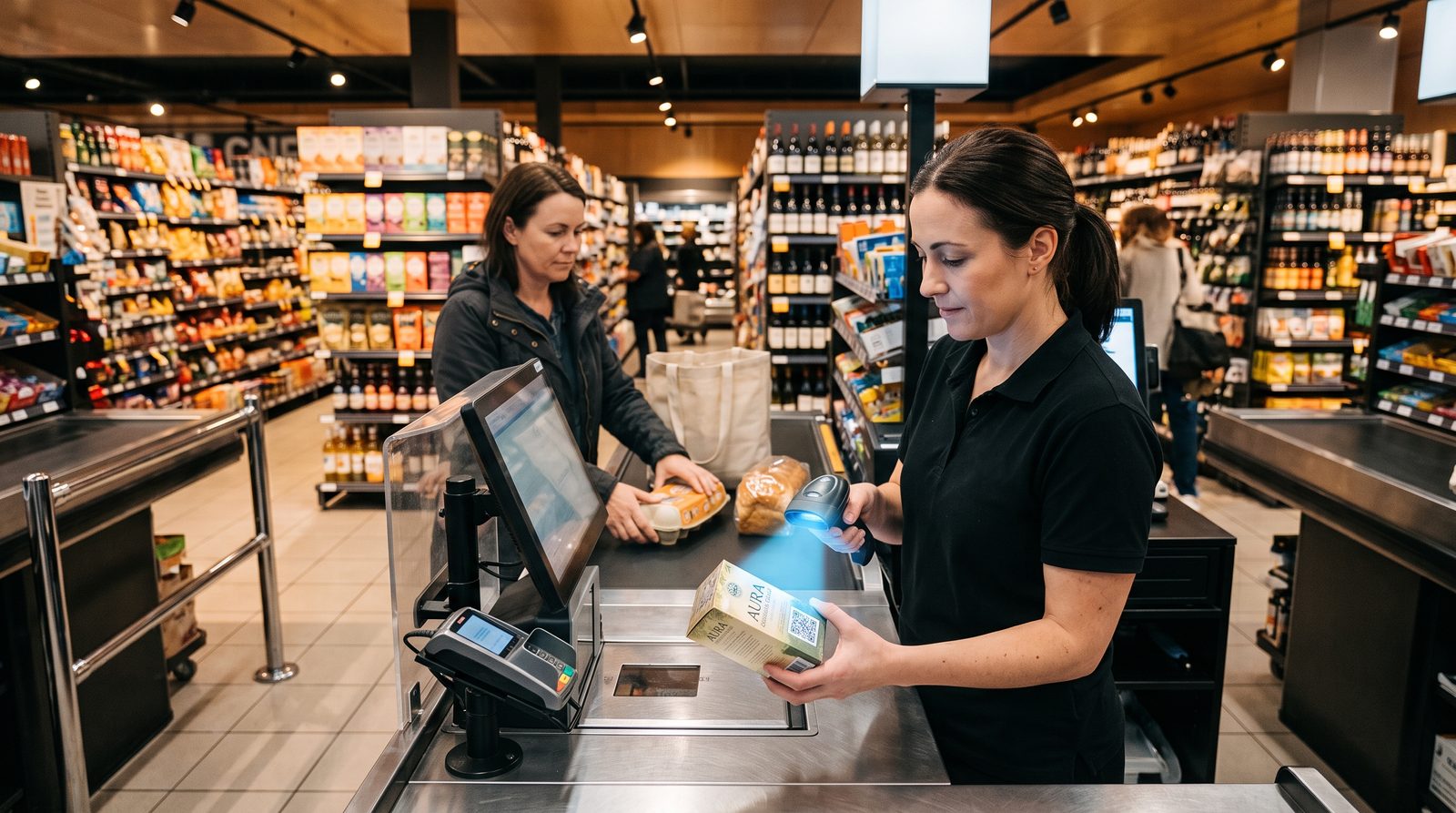
At a retail checkout terminal, the scanner extracts the GTIN from the URI and processes it exactly as it would a traditional barcode. At a consumer's phone camera, the same scan opens a browser to a product page the brand controls. The same physical code, serving two different audiences, from one printed asset.
The URI structure follows a standardized path format. A basic GS1 Digital Link encodes the GTIN using Application Identifier 01:
Additional data layers can be added for supply chain traceability — batch number (AI 10), serial number (AI 21), and expiry date (AI 17):
The domain in the URI is the brand's own domain — or a platform resolver domain — and it handles delivering the appropriate response depending on who is scanning and in what context.
The Digital Product Passport connection
The EU Digital Product Passport (DPP) is a separate regulatory program, but it is closely aligned with Sunrise 2027 in its technical requirements. From 2027, batteries sold in the EU must carry a digital passport accessible via a machine-readable code — and GS1 Digital Link is the recommended carrier format. Textiles, electronics, and other categories follow on a rolling timeline through 2030.
A brand building GS1 Digital Link compliance for Sunrise 2027 is simultaneously building much of the infrastructure it will need for Digital Product Passport compliance. The GTIN-based QR code, the product resolver, the data management layer — these are the same components both programs require. Treating them as one project rather than two reduces duplicated work significantly.
What your deadline actually looks like
GS1 places the formal Sunrise 2027 date at December 31, 2027. But the practical deadlines for brands arrive earlier, because packaging design cycles, printer transitions, and supply chain data setups all take time.
- 2026EU battery Digital Product Passport mandatory. GS1 Digital Link recommended as data carrier. Start generating compliant codes for EU market products now.
- Early 2027Major retailer supplier portals begin requiring 2D-ready packaging specifications for new product submissions. Packaging redesign cycles typically run 6–12 months.
- Dec 31, 2027GS1 Sunrise 2027 formal deadline. POS systems at Walmart, Target, Tesco, Carrefour and other committed retailers capable of reading 2D barcodes at checkout.
- 2028+Retailers begin using the additional data in 2D codes for dynamic pricing, real-time inventory, and automated recall management. Brands without 2D codes miss access to these capabilities.
How to generate a compliant GS1 Digital Link QR code
Generating a GS1 Digital Link QR code involves three steps: formatting the URI correctly, encoding it into a QR code at the right specification, and verifying the result scans correctly in both retail and consumer contexts.
Step 1 — Assemble your GS1 identifiers. You need a valid 14-digit GTIN (zero-padded if your product uses a 12-digit UPC or 13-digit EAN). If you are encoding traceability data, have your batch/lot format, serial number schema, and expiry date format ready.
Step 2 — Build the Digital Link URI. Use your own domain (recommended for long-term control) or a platform resolver. Format the path using Application Identifiers as path segments: /01/ followed by your 14-digit GTIN, then any additional AIs as path segments or query parameters.
Step 3 — Generate the QR code. Encode the full URI string into a QR code. Use error correction level M or H for retail packaging — higher error correction tolerates print imperfections better. Minimum print size at retail is typically 1cm × 1cm, though larger is better for reliable scanning at checkout speeds. GS1 recommends placing the 2D code within 50mm of the existing 1D barcode on packaging.
On MyQR Barcode Generator, GS1 Digital Link QR codes can be generated directly from the QR code type selector. Enter your GTIN, add optional batch, serial, and expiry fields, and download a print-ready file. For brands managing multiple SKUs, the bulk generator handles CSV input for generating a full product catalog of compliant codes in one pass.
What to do if you haven't started
If your current product packaging carries only a UPC or EAN barcode, start with a gap assessment:
- Confirm your GS1 company prefix is current. Log in to your GS1 member organization account and verify your prefix is active and your GTINs are registered in the GS1 Registry.
- Identify which products need 2D codes first. Prioritize products going to Walmart, Target, Tesco, or Carrefour — these retailers are earliest to require 2D readiness.
- Decide on a resolver strategy. Your own domain gives you full control. A platform resolver is faster to deploy. Either works for Sunrise 2027 compliance.
- Generate and test the codes. Test scanning with multiple devices and barcode scanning apps. Verify the checkout scan extracts the correct GTIN and the consumer scan opens the correct product page.
- Update packaging artwork. Work with your design team to place the 2D code on packaging within 50mm of the existing 1D barcode. Factor in your next packaging print run.
The brands that move early have a real advantage: they get practice runs before the deadline pressure arrives, they build the resolver infrastructure at their own pace, and they capture the consumer engagement benefits — scan-triggered product pages, recalls, and loyalty programs — before competitors do.
Generate GS1 Digital Link QR codes today
Build Sunrise 2027-compliant QR codes for your products. Single codes or full product catalog bulk generation — both from the same platform.
Get Started with GS1 Digital Link